
"Come on people now, smile on your brother, everybody get together, try to love one another right now"
Krist Novoselic’s Gibson Ripper: The Bass Behind Nevermind
A sourced deep dive on Krist Novoselic's Gibson Ripper bass: what it is, how he used it on Nevermind, the 1992 VMA toss, what happened to it, and how to get the sound.

If you picture Krist Novoselic on stage in 1991 or 1992, chances are the bass in your head is a big, double-horned Gibson Ripper. Krist says he recorded Nevermind on a blonde one, he threw an ebony one in the air at the 1992 MTV Video Music Awards, and he still has that one. This page pulls together what is actually documented about his Rippers: what the bass is, how he used it, what happened to his, and how to get close to the sound. We have kept to what we could source and flagged what we could not.
This is the deep dive on one bass. For the whole Nirvana-era rig, including the amps, see Krist’s Equipment. For every instrument he has played from 1987 to now, see the Krist Novoselic gear guide.
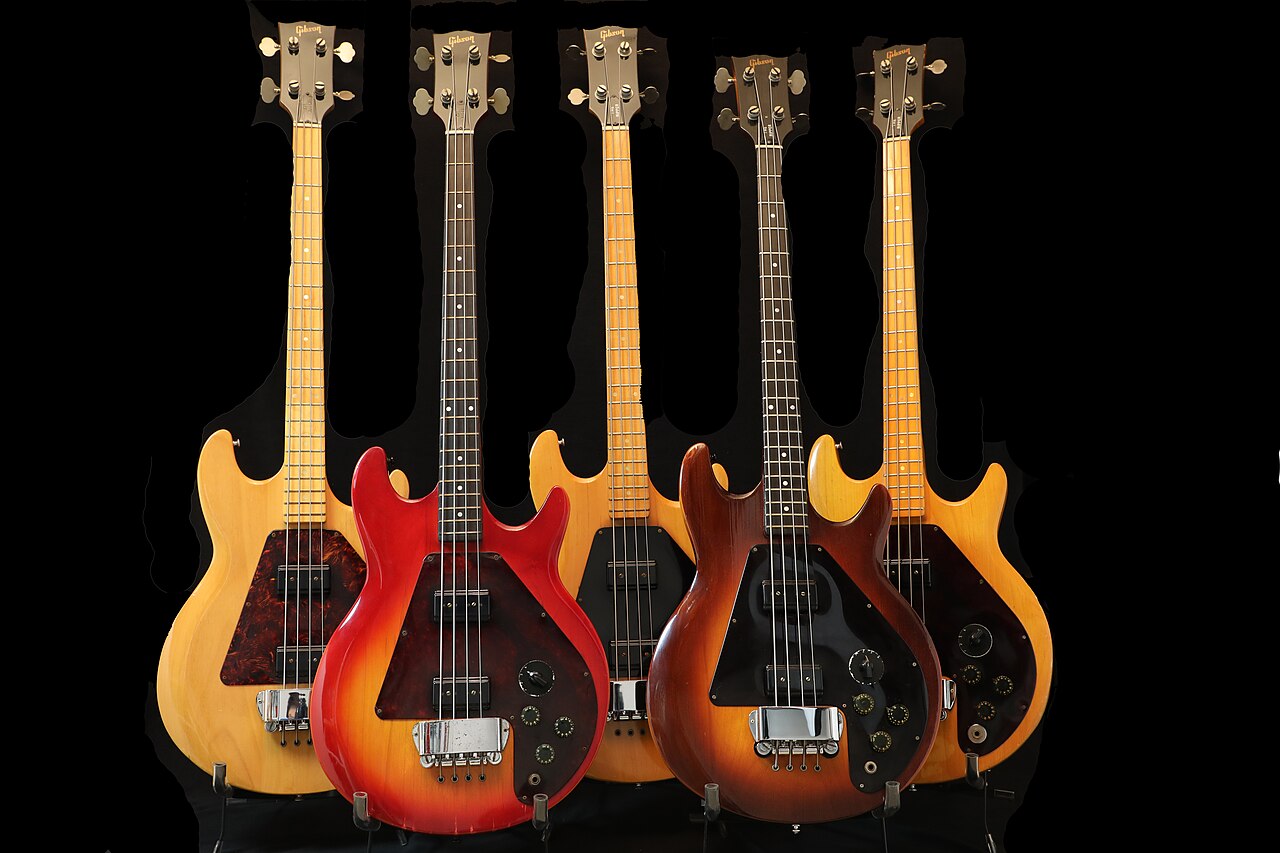
What is a Gibson Ripper?
The Ripper (catalog name L-9S Ripper) is a solid-body electric bass Gibson made from 1973 until the early 1980s (Wikipedia gives 1983). Wikipedia credits it to designer Bill Lawrence, who also designed its pickups, and says production peaked in 1976 (Wikipedia).
- Body and neck: maple body (alder on a batch from 1975) with a set, three-piece maple neck, a 34½-inch scale and 20 frets (Wikipedia; FlyGuitars).
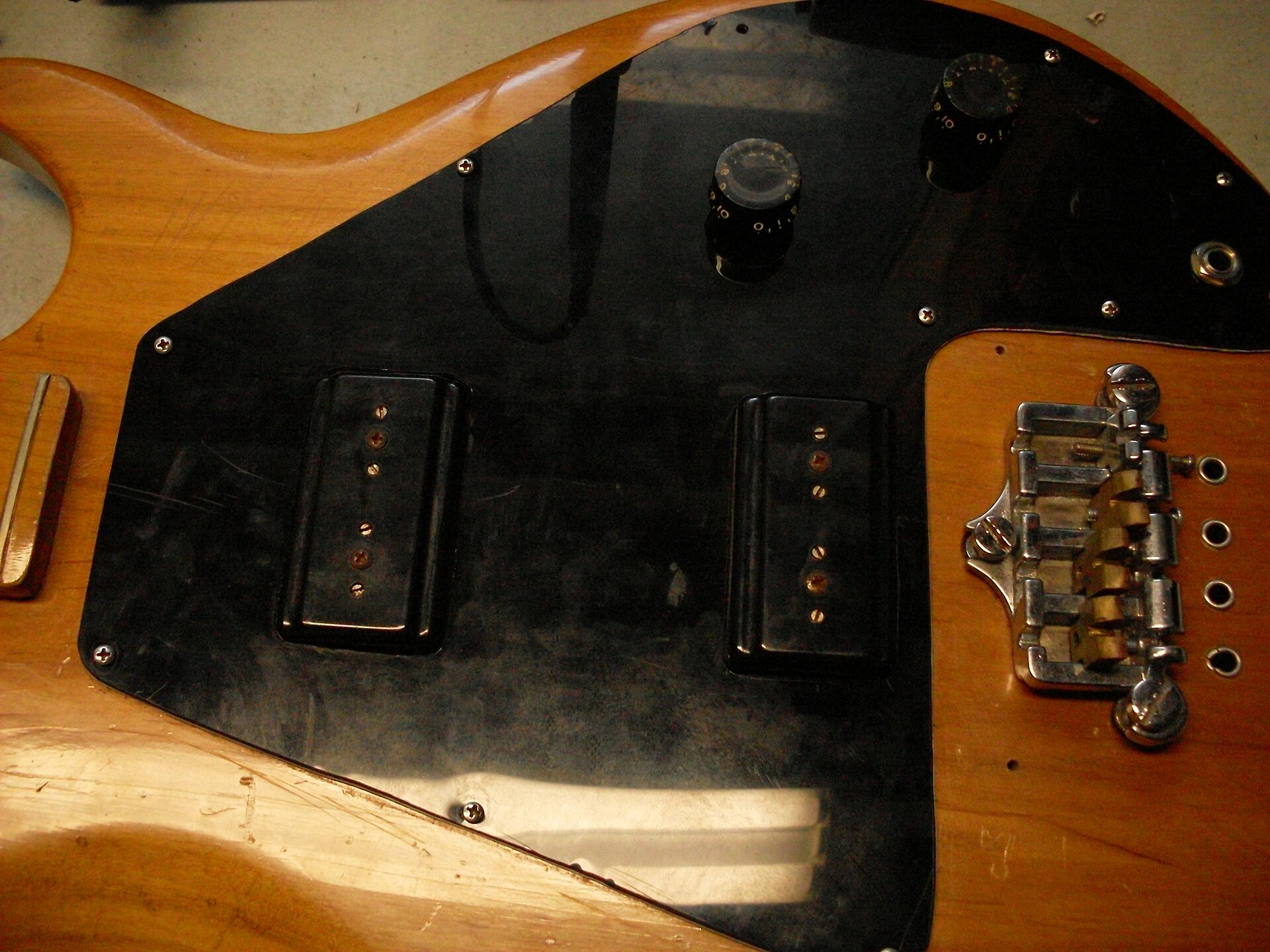
- Pickups and controls: two humbuckers Gibson called “Super Humbuckers,” with a “Q System” of one volume, one tone, a midrange roll-off and a four-position pickup selector. The positions range from the bridge pickup alone (the brightest) to both pickups wired in parallel (deeper and fuller) to an out-of-phase setting that is thin and sharp (Wikipedia).
- Finishes: natural, black (“ebony”) and tobacco sunburst were the standard options (Wikipedia).
- Relatives: the Ripper shares its body shape with the Grabber and the G-3, which have bolt-on necks instead of the Ripper’s set neck (Wikipedia).
Krist’s Rippers
Nirvana’s guitar tech Earnie Bailey told LiveNirvana that Krist owned at least two Rippers in ebony and two in natural (blonde), plus another in sunburst (LiveNirvana). Krist himself told Bass Player that he “played a blonde Ripper on Nevermind,” that two of his Rippers were stolen, and that the blonde one “sounded different from my other black one” (Bass Player via Guitar World).
Why a Ripper? Krist is six foot seven, and he told Bass Player it is “a big bass” that is “big and heavy, it’s a big gun,” with “that sustain that I really like.” He added that he stuck with Gibson basses “the whole way through, because they’re so dense” (Bass Player via Guitar World).
The Ripper on Nevermind
Nevermind was recorded in the spring of 1991, and Krist says the bass on it is the blonde Ripper (Bass Player via Guitar World). The amp, per Bailey, was most likely an Ampeg SVT 400T, which he says Krist had acquired by early 1991 (LiveNirvana). Producer Butch Vig told Sound On Sound that he put a Neumann FET 47 and an Electro-Voice RE20 on the bass amp and used only the 47, for its thumpy midrange. He also described using a Tech 21 SansAmp as a direct box, because it sounds more like an amp than a plain DI (Vintage King, quoting Sound On Sound).
Krist has described the approach in plain terms. The bass parts are simple and melodic, he told Bass Player, because he asks what the song needs, and he knew Kurt and Dave had to like them too (Bass Player via Guitar World).
On camera and on stage
- “In Bloom” (Sub Pop video): an ebony Ripper appears in some of the footage (LiveNirvana).
- “Come As You Are” video: Bailey says the Ripper in the video is the sunburst one (LiveNirvana). See the “could not verify” list below, because one fan-run history says otherwise.
- 1992 MTV Video Music Awards (Sept. 9, 1992): during “Lithium,” with his bass rig distorting badly, Krist did his usual bass toss. It hit the TV lights and came down on his head. Bailey says you may have seen a Ripper “smacking Krist in the face” at that show (LiveNirvana), and another fan history says it was the ebony one. Krist’s own account, with Axl Rose, Duff McKagan and Brian May’s champagne in it, is in his Seattle Weekly, Nov. 18, 2008 column, and our own 1992 MTV Music Awards post covers it too.
- Foo Fighters, 2011: when Krist guested on “I Should Have Known” for Wasting Light, he played “lead bass” on a Gibson Ripper the studio had on hand, through a Rat distortion pedal, and the band made him play whole takes to tape (Bass Player via Guitar World).
What happened to Krist’s Rippers?
- Two were stolen. Krist said so in the Bass Player interview, though he did not say when or where (Bass Player via Guitar World).
- The VMA bass survived. In his Seattle Weekly column Krist wrote: “I still have that bass guitar, too. I don’t play it much. The neck is a little bent!!!” (Seattle Weekly, Nov. 18, 2008). Rolling Stone reported that he still owns it (Rolling Stone). That was 2008. We have not found a more recent statement about it.
- No Krist Ripper is known to be in a museum. His Ibanez Black Eagle is on display at MoPOP in Seattle, but we found nothing saying a Ripper is.
Can you buy a Ripper today?
Not new from Gibson, as far as we can find. Gibson brought the Ripper back once, in 2009, as a limited “Ripper II” with Seymour Duncan-made pickups and a six-position switch (Wikipedia). Sweetwater’s old listing says only 350 were planned and calls it a 34-inch scale (Sweetwater). It is no longer sold new. We found no Ripper in Gibson’s current lineup, although we could not confirm that on Gibson’s own site.
- Original 1970s Rippers still turn up used. Krist said in 2012 that old basses like them go “really fast” on eBay for “like 2500 bucks” (Bass Player via Guitar World). Prices have almost certainly risen since, so check current listings.
- Epiphone Ripper (limited edition, 2006 to 2008) is a bolt-on neck copy with a different pickup setup, so it looks right but is not the same bass (Epiphone Wiki).
- Epiphone Grabber (reissued September 2024) shares the Ripper’s body shape and sells for $999 (Guitar World). Epiphone’s own announcement lists Krist among players of the Grabber, but we found no first-hand source that he played one, and it is a different instrument with a single humbucker and a bolt-on neck.
- Krist’s signature Gibson RD (2011) is a different bass, one he also played in the early 1990s. It is not a Ripper. Krist described it to Bass Player (Bass Player via Guitar World), and it is covered on Krist’s Equipment. There has been no Ripper signature model that we know of.
How to get the Ripper sound
None of this makes a replica of Krist’s sound, but these are the documented pieces:
- A Ripper, or the closest thing. Try the Q System positions. The bridge-only setting is the brightest; both pickups in parallel is the fuller one (Wikipedia).
- Strings: Rotosound RS66 long-scale, standard gauge, per Bailey (LiveNirvana).
- Amp: an Ampeg SVT-style head. Vig said Krist’s Nevermind bass went through an Ampeg SVT (Vintage King, quoting Sound On Sound), and Bailey says the SVT 400T (LiveNirvana).
- Recording: Vig’s approach was a condenser mic like the FET 47 on the amp, plus a direct signal with some amp character, such as a SansAmp-style box (Vintage King, quoting Sound On Sound).
- Dirt: Krist’s distortion pedal of choice was a ProCo Rat 2, per Bailey (LiveNirvana); he also used it on the Foo Fighters session (Bass Player via Guitar World).
- Playing: keep the part simple and let the notes ring. That sustain is what Krist said he liked about the Ripper (Bass Player via Guitar World).
What we could not verify
- Which Ripper is in the “Come As You Are” video. Bailey says sunburst. A fan-run history, Which Bass, says blonde. We have not seen the footage settled by a first-hand source.
- When Krist got each Ripper. Which Bass dates the ebony Ripper to about February 1990 and the blonde to August 1990. That is a secondary source, so we are not stating those dates as fact.
- Where and when the stolen Rippers disappeared. Which Bass says one was stolen at the Reading Festival. We have not found a primary source for that.
- Rippers on In Utero. Which Bass says Bailey reported Rippers on that album. We could not find that in Bailey’s LiveNirvana interview, so we left it out.
- Whether the VMA bass is the same ebony Ripper he used on tour. Krist’s column does not name the model. Bailey says it was a Ripper, and fan histories say ebony.
- Whether the 2024 Epiphone Grabber has any link to Krist beyond Epiphone’s marketing line.
Have a photo, a liner note or an interview that settles one of these? Contact the webmaster.
Featured photo: five all-original Gibson Rippers from 1973 and 1974 (not Krist’s instruments). Photo by Spwood, CC BY-SA 4.0, via Wikimedia Commons.
Sources: Bass Player (2012) via Guitar World, LiveNirvana equipment guide (Earnie Bailey), Krist Novoselic, Seattle Weekly (2008), Rolling Stone (2008), Vintage King (quoting Sound On Sound), Wikipedia: Gibson Ripper, Wikipedia: 1992 MTV VMAs, FlyGuitars, Sweetwater: Ripper II, Epiphone Wiki, Guitar World: Epiphone Grabber (2024), Which Bass (fan history, secondary).
The Krist Novoselic Dedication Page is an unofficial fan site and is not affiliated with Krist Novoselic, Nirvana or Gibson.